Tri-Agency Workforce Initiative
 Workforce Education and Literacy
Workforce Solutions Pathways in Action: Work-Based Learning
The Gulf Coast Workforce Board envisions a region where learners can move seamlessly from education to meaningful careers. Through the Texas Tri-Agency initiative, the Gulf Coast region is strengthening connections among education, workforce development, and industry to help students explore careers, develop in-demand skills, gain workplace experience, and prepare for long-term career success.
Work-Based Learning (WBL) is central to this effort.
For the Gulf Coast Workforce Board, Work-Based Learning is not a single program or activity. It is a continuum of employer-connected experiences that helps learners understand career opportunities, prepare for the workplace, develop technical and professional skills, and ultimately apply those skills in real-world settings.
By bringing together K-12 education, higher education, workforce partners, employers, and community organizations, the Gulf Coast region is building stronger pathways between learning and the workforce while helping employers develop the talent they need for the future.
The Gulf Coast Regional Definition of Work-Based Learning
The Gulf Coast region defines Youth Work-Based Learning as: A continuum of structured, employer-connected learning experiences that enable students to explore, prepare for, and engage in careers while progressing through their educational journey.
This definition recognizes that career development is a progression, not a single event. As learners develop greater awareness, skills, and career clarity, their experiences should become increasingly immersive and connected to the workplace.
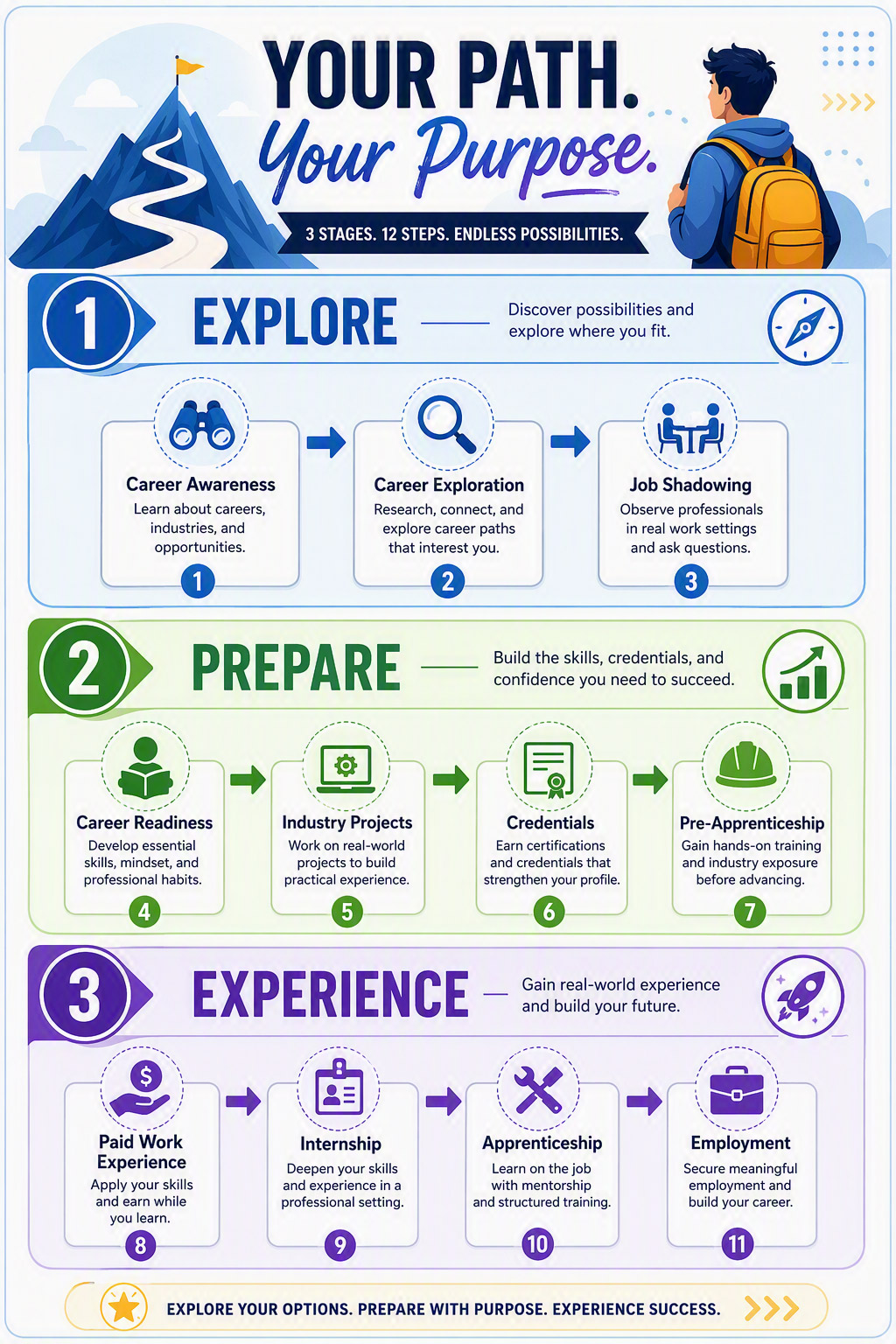
The Gulf Coast model organizes this progression around three interconnected stages:
Explore → Prepare → Experience
Explore: Discovering Career Possibilities
Career exploration is the foundation of the Gulf Coast approach.
Before learners can make informed decisions about education, training, or careers, they need opportunities to understand their interests and strengths, discover occupations, learn about regional workforce demand, and see how classroom learning connects to the world of work.
Career exploration may include:
- Career assessments and interest inventories
- Career fairs and career days
- Employer and industry guest speakers
- Workplace tours and industry site visits
- Job shadowing
- Career-focused classroom projects
- Regional labor market and career information
These experiences help learners answer an important first question: What careers might be right for me?
Prepare: Building Skills for the Future
As learners identify career interests, the next stage focuses on developing the skills, knowledge, and competencies needed to pursue those opportunities.
Career preparation experiences may include:
- Employer and professional mentoring
- Industry-led projects and challenges
- Career and Technical Education experiences
- Employability and professional skills development
- Industry-recognized credential opportunities
- Pre-apprenticeship programs
- Simulated workplace experiences
At this stage, learners move from discovering possibilities to understanding what it takes to succeed in their chosen pathways.
Experience: Learning Through Work
The continuum progresses to increasingly immersive experiences that allow learners to apply their knowledge and skills in authentic workplace environments.
Experiences may include:
- Paid work experiences
- Internships
- Youth apprenticeships and registered apprenticeships
- Clinical experiences
- Cooperative education
- On-the-job learning and training
These experiences help learners build workplace competencies, professional networks, confidence, and experience while providing employers an opportunity to develop and engage emerging talent.
Career Exploration First
The Gulf Coast region embraces a Career Exploration First philosophy: learners make stronger education and career decisions when they have meaningful opportunities to explore careers before committing to a pathway.
Rather than expecting students to select a career with limited exposure to the world of work, the regional approach prioritizes early and ongoing opportunities to:
- Identify interests, strengths, and aspirations
- Explore multiple careers and industries
- Understand regional labor market demand
- Connect academic learning to real-world applications
- Learn directly from employers and working professionals
- Make informed decisions about education, training, and career pathways
Career exploration is therefore not an isolated activity. It is the foundation for increasingly focused career preparation and work-based learning experiences.
Employers at Every Stage
Employer engagement is embedded throughout the Gulf Coast Work-Based Learning continuum.
Employers are more than the final destination for talent. They are partners in developing it.
Employers can engage at multiple points by:
- Speaking with students about careers and industries
- Hosting workplace tours and job shadows
- Serving as mentors
- Providing industry-based projects and challenges
- Advising educators and workforce partners about skills and workforce needs
- Offering internships, work experiences, and apprenticeships
- Helping validate workplace competencies and industry expectations
This employer-connected approach helps ensure that career-connected learning remains relevant to the region's economy and responsive to evolving workforce needs.
Building a Stronger Gulf Coast Talent Pipeline
Work-Based Learning benefits learners, employers, educational institutions, and the broader regional economy.
Through the Tri-Agency initiative, the Gulf Coast region is working to expand high-quality career-connected learning, strengthen transitions between education and employment, increase exposure to high-demand and high-growth careers, and create stronger connections between regional employers and emerging talent.
The regional approach seeks to:
- Expand access to career exploration and Work-Based Learning
- Increase awareness of high-demand and high-growth career pathways
- Strengthen employability, technical, and workplace skills
- Support attainment of industry-valued credentials where appropriate
- Improve transitions to postsecondary education, training, and employment
- Increase employer participation in talent development
- Strengthen regional talent pipelines
- Support economic mobility and regional competitiveness
From Exploration to Opportunity
The Gulf Coast vision is simple: learners should have opportunities to see what is possible, understand how to get there, and gain the experiences necessary to move forward.
Through a coordinated continuum of Explore, Prepare, and Experience, the Gulf Coast region is connecting education with opportunity and creating clearer pathways from the classroom to careers.
Explore possibilities. Prepare for opportunity. Experience the world of work.
That is Work-Based Learning in the Gulf Coast region.
EXPLORE
Career Awareness → Career Exploration → Job Shadowing
PREPARE
Career Readiness → Industry Projects → Credentials → Pre-Apprenticeship
EXPERIENCE
Paid Work Experience → Internship → Apprenticeship → Employment
Pathways in Action: Construction Regional Workforce Summit June 11, 2026
The Construction Futures Summit, held June 11 at Wharton County Junior College, launched the Gulf Coast Workforce Board’s 2026 Summer Regional Summit Series. The event brought together 75 employers, educators, workforce organizations, and community stakeholders to address workforce needs in the region’s construction, industrial, and energy sectors.
Through presentations and discussions led by industry and education leaders, participants explored workforce challenges, hiring demands, and the skills most critical for success, including safety, technical expertise, adaptability, and continuous learning. The summit also highlighted the value of registered apprenticeships and industry-aligned training programs in developing a skilled workforce. Overall, the event emphasized collaboration among employers, educators, and workforce partners to strengthen talent pipelines and expand pathways into high-demand careers.

Pathways in Action: Life Sciences & Healthcare Regional Workforce Summit June 18, 2026
The Life Sciences & Healthcare Futures Summit, held June 18 in partnership with San Jacinto College, brought together 99 healthcare leaders, life sciences professionals, educators, workforce partners, and community stakeholders. The summit focused on strengthening the workforce ecosystem supporting healthcare, biotechnology, biomanufacturing, and life sciences across the Gulf Coast region.
Through discussions on industry needs, workforce development, and education partnerships, participants explored strategies to build sustainable talent pipelines, expand industry-responsive training, and meet evolving workforce demands while increasing access to high-growth, high-demand careers.
Pathways in Action: Education Regional Workforce Summit July 16, 2026
The Education Futures Summit, held July 16 at Lone Star College, concluded with the Gulf Coast Workforce Board’s 2026 Summer Regional Summit Series. The event brought together 184 educators, workforce leaders, policymakers, community partners, and employers, making it the largest-attended summit in the series.
Discussions focused on strengthening connections between education and workforce systems to better prepare students for lifelong success and economic mobility. Through keynote presentations, employer insights, workforce program highlights, and education and training discussions, participants explored strategies to align career pathways, expand partnerships, and supported smoother transitions from education to meaningful employment while meeting regional workforce needs.
Gulf Coast Workforce Board Pathway Leadership Tri Agency Meetings
The Texas Regional Pathways Network (TRPN) strengthens talent pipelines by bringing together education, workforce, business, and community partners to build career pathways for high-demand, high-wage jobs. Through shared learning, partners exchange best practices and solve problems more efficiently, while economies of scale allow for shared resources and reduced duplication of efforts. This collaboration increases staff capacity by streamlining processes and minimizing workload, and it promotes the use of shared data and metrics to track progress and improve outcomes. Overall, TRPN enhances efficiency, alignment, and impact, helping partners work together more effectively to support student success and regional economic growth.
 Gulf Coast Workforce Board Pathway Leadership Tri Agency Meeting Presentation 2-24-2026
January 29, 2025 | The Ion - Houston
Empowering the Next Generation: 2025 Conference Unites Over 430 Students Across the Gulf Coast
The 2025 Regional Convener Conference, held on January 29, was a resounding success, uniting over 430 students from across the Gulf Coast region for a full day of professional development, career exploration, and networking. Led by Regional Educational Convener Roderick Peoples under the direction of Danielle Knotts, the conference provided tailored programming aimed at equipping students with tools to chart successful career paths.
A Day of Purposeful Engagement

The conference kicked off with a warm welcome from Juliet Stipeche, setting a positive and encouraging tone for the day. Students from Willis ISD, Houston ISD, Galveston ISD, Spring ISD, and homeschool programs attended, reflecting a broad and diverse student body committed to career readiness.
Participants began with two impactful breakout sessions:
- Self-Discovery & Personal Mission: Students engaged in reflective activities and career assessments to better understand their strengths, values, and passions. They were guided in crafting their personal mission statements and developing career goals aligned with their identities.
- Professional Presence & Career Readiness: This session covered resume and LinkedIn profile building, interview attire and communication skills, and the importance of maintaining a professional digital footprint.
A Unified Vision for the Future
With 433 confirmed attendees, the 2025 Regional Convener Conference successfully brought together a diverse cohort of students and professionals, united by a shared commitment to career development and workforce alignment. Through engaging sessions, real-world insights, and meaningful connections, the event provided students with the confidence and tools to take the next steps toward a promising future.
The success of the conference reflects the collective effort of educators, workforce leaders, and industry professionals working together to build a stronger, more connected Gulf Coast region—where every student is empowered to succeed.
Connecting Students with Opportunity
The conference also spotlighted the Hire Gulf Coast Youth initiative, presented by Jalil and LaToya, which connects students with job opportunities and local employers. Their in-depth overview sparked student interest and highlighted clear, actionable steps toward employment.
The Employer Panel was another pivotal component, featuring:
- Lacy Wolf, Construction and Building Trades Liaison, GCWB
- Melissa Steinmetz, Health Care Life Sciences Principal Liaison, GCWB
- Amber Jefferson, IT Principal Liaison, GCWB
- Moderated by Crosby Brito
Panelists provided insights into workforce trends and career pathways in healthcare, construction, IT, and manufacturing, helping students visualize their place in these vital industries.
Facilitating Growth Through Guidance and Engagement
Key facilitators Jessica Savala, Community Engagement Coordinator, and William McQueen, Community Engagement Facilitator, played a central role in leading student discussions and breakout sessions. Their efforts helped foster an engaging, supportive environment where students could explore, connect, and grow.
Inspiration from Industry Leaders
A highlight of the day was the keynote address by Andre’a Streeter, a leader at Microsoft. Sharing her journey from designing systems for NASA’s International Space Station to leading global strategy for Microsoft Azure, Andre’a inspired students to pursue careers in STEM, emphasized the importance of diversity in tech, and encouraged perseverance in fast-evolving industries.
Students also gained a deeper understanding of regional economic trends through a presentation by Parker Harvey, Manager of Regional Economic Analysis at the Gulf Coast Workforce Board (GCWB). His walkthrough of the HSHG Tableau Dashboard illustrated the demand for sustainable career paths in high-growth sectors across the region.
June 9–14, 2024 | Rice University, Houston, TX
Summer Work-Based Learning Program at Rice University Connects Students to High-Demand Careers
75 high school students from across Texas participated in the Summer Work-Based Learning: Convener Summer Program—a transformative, week-long residential experience at Rice University focused on exploring high-demand careers in healthcare, construction, and education.
Hosted in partnership by the Texas Education Agency, Gulf Coast Workforce Board, Workforce Solutions, and the Rice University Tapia Center, the program offered students a rare opportunity to live on campus, engage with professionals, and gain firsthand exposure to real-world career paths through industry site visits, hands-on activities, and leadership development.
Out of more than 300 applicants, 75 rising freshmen, sophomores, and juniors were selected to attend. All students received free room and board, meals, transportation, and supplies—and those who completed the program were awarded a $500 stipend in recognition of their commitment and participation.
A Launchpad for the Future
The success of the Summer Work-Based Learning Program was made possible by the dedication of educators, employers, and program staff who worked behind the scenes to coordinate logistics, ensure student support, and deliver a seamless, high-impact experience.
Program Highlights: A Week of Career Exploration
Sunday, June 9 – Welcome & Orientation
Students checked into the Rice campus and kicked off the week with team-building activities and an overview of what to expect.
Monday, June 10 – Career Exploration & Project-Based Learning
Students explored regional high-growth industries and began collaborative projects designed to deepen their understanding of career pathways.
Tuesday, June 11 – Healthcare Day
Visits to Methodist Hospitals, HCC Coleman College, and a panel with professionals from MD Anderson provided students with insight into medical careers and health systems operations.
Wednesday, June 12 – Building & Construction Day
Students explored the trades through immersive visits to the Pipefitters Union, Electrical Union, Houston METRO apprenticeship facility, and the Houston Ship Channel.
Thursday, June 13 – Education & Technology Day
Students explored emerging roles in education and tech, attending panels with educators and program leaders, and touring the ION innovation hub, HCC AI Lab, and Rice’s Kinder Institute.
Students presented their weeklong projects, celebrated their accomplishments, and received certificates of completion and $500 stipends in a special closing ceremony.
January 31, 2024 | The Ion - Houston
Reimagine Education and Workforce Alignment
On Wednesday, January 31, 2024, educators, workforce professionals, industry leaders, and community partners from across the Gulf Coast region convened at The Ion in Houston for the inaugural Regional Education Convener Conference. This first-of-its-kind gathering, hosted by the Gulf Coast Workforce Board, aimed to strengthen collaboration between education and workforce systems and align regional efforts to better prepare young people for high-demand careers.
A Day of Insight, Innovation, and Collaboration
The event began with a networking breakfast, setting the stage for a day full of shared insights and strategic conversations. Attendees quickly engaged in meaningful dialogue around the region's challenges and opportunities in career readiness and workforce development.
At 9:30 a.m., Juliet Stipeche, Executive Director of the Gulf Coast Workforce Board, welcomed attendees with opening remarks that underscored the importance of regional coordination and innovation in education-to-career pathways—particularly in high-growth sectors such as construction, healthcare, and technology.
Participants were then invited to explore The Ion, Houston’s innovation hub, during a guided tour, while others attended a concurrent Youth & Career Services Presentation. This session shared best practices in student engagement and workforce preparation programs that support long-term career success.
A Launchpad for Regional Change
The 1st Regional Education Convener Conference was more than a one-day event it was the beginning of a movement toward stronger alignment between education systems and workforce needs. By convening leaders from K-12, higher education, industry, and community organizations, the conference laid the foundation for impactful partnerships and regional transformation.
As participants departed The Ion, they left with new ideas, valuable connections, and a shared commitment to equipping the next generation for success in a dynamic, opportunity-filled economy.
Focused Workshops and Data-Driven Dialogue
In the afternoon, attendees engaged in the ALICE Workshop presented by United Way, which addressed the unique needs of Asset-Limited, Income-Constrained, Employed (ALICE) individuals. The session focused on how schools and workforce systems can implement supports that meaningfully impact low-income working families.
A key data-focused highlight of the day was the GAP Analysis Presentation, delivered by Dr. Horn and Cami Anderson of ThirdWay Solutions. The session took a deep dive into disparities between education outcomes and labor market demands, sparking conversations around strategic alignment and regional solutions.
Fostering Innovation Through Entrepreneurship
The day concluded with a powerful Entrepreneurship Panel, featuring CTE students and educators who shared their experiences fostering entrepreneurial mindsets in the classroom. Their stories underscored the need for adaptability and innovation in preparing students for evolving industries.
Industry Panels and Practical Tools
The morning continued with the Career Exploration & Apprenticeship Panel, moderated by the Gulf Coast Workforce Board and featuring insights from:
- Paul Puente – Gulf Coast Workforce Board
- Carla Thompson – Turner Construction
- Erica Castro – HCA Healthcare
Panelists highlighted the value of industry-education partnerships in expanding access to apprenticeships and hands-on career experiences for students.
This was followed by a Career Exploration Demo led by Parker Harvey, showcasing tools and technology that help students navigate labor market trends and explore viable career pathways.